|
 |
近年來人工智慧 (Artificial Intelligence, AI) 工具在學術研究生命週期(Research Lifecycle)的應用越來越廣泛,從多語言文獻檢索、數據收集與分析、圖像或圖形元素製作到論文撰寫等,皆可善用AI工具的優勢,提升學術研究與成果產出的效能。然而,大型語言模型等工具雖在研究活動有其貢獻的價值,卻也產生關於作者身份 (authorship) 和內容原創性的議題,尤其是在ChatGPT被列為共同作者的論文出版時,引起研究人員與出版社的高度關注,進而規範AI工具在學術著作成果定位。
就學術倫理而言,國際出版倫理委員會 (Committee on Publication Ethics, COPE) 聲明作者必須對所提交內容的原創性、有效性和完整性負責。AI工具無法對提交的作品負責,做為非法人實體,它們無法斷言是否有利益衝突,也無法管理版權和授權協議,未能符合所謂作者身分的實際要求,因此,不能被列為論文作者。COPE也提醒研究人員在使用AI工具產生學術著作時,需要在Material或是Methods清楚地揭露使用何種工具、如何使用、以及使用後所產生的成果。倘若由AI工具產生的部分有任何違反出版的道德行為時,作者也必須對著作擔負全部責任。
AI@學術研究活動 出版社對AI的規範
 |
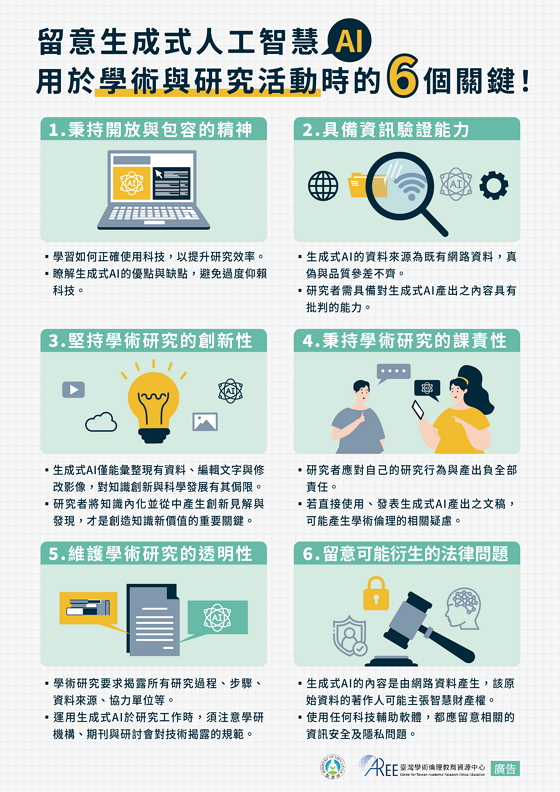
| AI工具將會持續且廣泛的運用於研究活動與研究過程,為提供研究同仁相關的因應之道,圖書館引用教育部臺灣學術倫理教育資源中心所製作的「使用生成式人工智慧在學術與研究活動時的六項關鍵」,摘錄重點供同仁參考。 |
| 一、秉持開放與包容的精神 |
| |
學習如何正確使用科技提升研究效率,瞭解生成式AI的優缺點,避免過度仰賴科技。 |
| |
|
| 二、具備資訊驗證能力 |
| |
生成式AI資料來源為既有網路資料,真偽與品質參差不齊,研究者必須對其產出內容有批判的能力。 |
| |
|
| 三、 堅持學術研究的創新性 |
| |
生成式AI僅能對現有資料、編輯文字與修改影像,對知識創新與科學發展有所侷限。研究者將知識內化並從中產生創新見解與發現,是創造知識新價值的重要關鍵。 |
| |
|
| 四、 秉持學術研究的課責性 |
| |
研究者應對自己的研究行為與產出負全部責任,若直接使用或發表由生成式AI產出的文稿,可能有學術倫理的相關疑慮。 |
| |
|
| 五、 維護學術研究的透明性 |
| |
學術研究必須揭露所有研究過程、步驟、資料來源與協助單位等,運用生成式AI必須注意研究機構、期刊與研討會等對產出揭露的規範。 |
| |
|
| 六、留意可能衍生的法律問題 |
| |
生成式AI內容的原始資料著作人可能主張智慧財產權;再者,使用任何輔助軟體都要留意資訊安全與隱私問題。 |
| ⚊⚊⚊⚊⚊ 出版社對AI的規範 ⚊⚊⚊⚊⚊ |
| 圖書館也彙整ACS、ELSEVIER以及Springer Nature等出版社,對於使用AI在論文產出的Authorship以及學術倫理的相關規範資訊,供同仁投稿前詳閱。 |
| ❚ American Chemical Society_ACS Author Guideline |
| Artificial intelligence (AI) tools do not qualify for authorship.The use of AI tools for text or image generation should be disclosed in the manuscript within the Acknowledgment section with a description of when and how the tools were used. For more substantial use cases or descriptions of AI tool use, authors should provide full details within the Methods or other appropriate section of the manuscript. |
| |
| ❚ ELSEVIER_The use of generative AI and AI-assisted technologies in writing for Elsevier |
| Authors should not list AI and AI-assisted technologies as an author or co-author, nor cite AI as an author. Elsevier does not permit the use of generative AI or AI-assisted tools to create or alter images in submitted manuscripts.This may include enhancing, obscuring, moving, removing, or introducing a specific feature within an image or figure. Adjustments of brightness, contrast, or color balance are acceptable if they do not obscure or eliminate any information present in the original. Image forensics tools or specialized software might be applied to submitted manuscripts to identify suspected image irregularities. The only exception is if the use of AI or AI-assisted tools is part of the research design or research methods (such as in AI-assisted imaging approaches to generate or interpret the underlying research data, for example in the field of biomedical imaging). If this is done, such use must be described in a reproducible manner in the methods section. This should include an explanation of how the AI or AI-assisted tools were used in the image creation or alteration process, and the name of the model or tool, version and extension numbers, and manufacturer. Authors should adhere to the AI software’s specific usage policies and ensure correct content attribution. Where applicable, authors could be asked to provide pre-AI-adjusted versions of images and/or the composite raw images used to create the final submitted versions, for editorial assessment. The use of generative AI or AI-assisted tools in the production of artwork such as for book or commissioned content covers or graphical abstracts is not permitted. |
| |
| ❚ Springer-Nature_Our editorial policies |
We believe in using AI responsibly and for the benefit of the research community, our authors, editors and readers, and our staff. We achieve this by being committed to adopting an ethically-focused approach while using, designing, developing, and deploying AI based solutions. We design and use solutions which contain AI or are enabled by AI responsibly, making sure that we consider and mitigate any negative impact, be it societal or environmental. We place human-centered values at the heart of our approach to the responsible use of AI, and these are reflected in our AI Principles and editorial policies. Below are links to our current editorial policies concerning the use of AI. Springer Nature is monitoring ongoing developments in this area closely and will review and update these policies as appropriate.
• SN does not attribute authorship to AI.
• SN does not allow the inclusion of generative AI images in our publications.
• SN asks peer reviewers not to upload manuscripts into generative AI tools. |
| |
| ❚ Taylor & Francis_Clarifies the Responsible use of AI Tools in Academic Content Creation |
| Authorship requires taking accountability for content, consenting to publication via an author publishing agreement, giving contractual assurances about the integrity of the work, among other principles. These are uniquely human responsibilities that cannot be undertaken by AI tools. Therefore, AI tools must not be listed as an author. Authors must, however, acknowledge all sources and contributors included in their work. Where AI tools are used, such use must be acknowledged and documented appropriately. |
| |
| ❚ WILEY_Clarifies the Responsible use of AI Tools in Academic Content Creation |
| Generative Artificial Intelligence tools (GenAI)—such as ChatGPT and others based on large language models (LLMs)—can increase productivity and foster innovation if used appropriately in a safe, ethical and secure manner. STM has general guidance for all stakeholders in scholarly publishing which addresses the role of generative AI technologies. If an author has used a GenAI tool to develop any portion of a manuscript, its use must be described, transparently and in detail, in the Methods section (or via a disclosure or within the Acknowledgements section, as applicable). The author is fully responsible for the accuracy of any information provided by the tool and for correctly referencing any supporting work on which that information depends. GenAI tools must not be used to create, alter or manipulate original research data and results. Tools that are used to improve spelling, grammar, and general editing are not included in the scope of these guidelines. The final decision about whether use of a GenAI tool is appropriate or permissible in the circumstances of a submitted manuscript or a published article lies with the journal’s editor or other party responsible for the publication’s editorial policy. GenAI tools cannot be considered capable of initiating an original piece of research without direction by humans. Tools cannot be accountable for a published work or for research design, which is a generally held requirement of authorship (as discussed in the Authorship section in these guidelines), nor does it have legal standing or the ability to hold or assign copyright. Therefore—in accordance with COPE’s position statement on Authorship and AI tools—these tools cannot fulfil the role of, nor be listed as, an author of an article. |
| |
Reference List
- American Chemical Society Author Guideline.
- COPE position statement. Authorship and AI tools.
- Elsevier. The use of generative AI and AI-assisted technologies in writing for Elsevier .
- Springer-Nature. Our editorial policies.
- Taylor & Francis. Clarifies the Responsible use of AI Tools in Academic Content Creation.
- WILEY. Best Practice Guidelines on Research Integrity and Publishing Ethics.
- 教育部臺灣學術倫理教育資源中心(2023)。留意生成式AI(AI)用於學術與研究活動時的6個關鍵!〔海報〕。
|
| |
 |
|